|
|
|||||
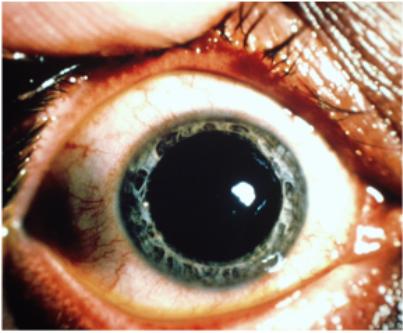
Corneal AbrasionDefinition: Injury to the epithelial surface of the cornea. Examples:
Symptoms: pain, foreign body sensation, tearing, photophobia, conjunctival injection. Signs: positive fluorescein
staining of a corneal epithelial surface defect in the eye
Differential Diagnosis: herpes simplex keratitis, recurrent corneal erosion
Evaluation:
Treatment: In general terms, is to encourage healing while preventing infection and relieving patient discomfort.
Causes: The more common causes will usually be from injury from fingers
accidentally thrust into the eye, or from foreign material blown into the
eye and subsequent rubbing of the eye.
Prognosis (consequences): Generally the prognosis of this kind of injury is good. Occasionally it can lead to incomplete healing and a condition known as corneal erosion (chronic abrasion). This condition may generally lead to a period of sick-in-quarters (SIQ) or light duty for 24 to 48 hours depending on the extent of the abrasion and the job of the patient. Small abrasions heal in 24 hours, larger and more resistant to therapy
may take 48 to 72 hours to resolve.
This section provided by CAPT Robert B. North, Jr., MC, USN
Home · Military Medicine · Sick Call · Basic Exams · Medical Procedures · Lab and X-ray · The Pharmacy · The Library · Equipment · Patient Transport · Medical Force Protection · Operational Safety · Operational Settings · Special Operations · Humanitarian Missions · Instructions/Orders · Other Agencies · Video Gallery · Forms · Web Links · Acknowledgements · Help · Feedback Approved for public release; Distribution is unlimited.
*This web version is provided by The Brookside Associates, LLC. It contains original contents from the official US Navy NAVMED P-5139, but has been reformatted for web access and includes advertising and links that were not present in the original version. The medical information presented was reviewed and felt to be accurate in 2001. Medical knowledge and practice methods may have changed since that time. Some links may no longer be active. This web version has not been approved by the Department of the Navy or the Department of Defense. The presence of any advertising on these pages does not constitute an endorsement of that product or service by either the US Department of Defense or the Brookside Associates. The Brookside Associates is a private organization, not affiliated with the United States Department of Defense.
© 2015, Brookside Associates, LLC. All rights reserved
|
|
||||