|
|
|||||
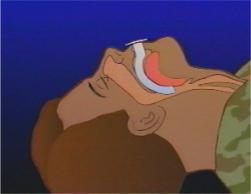
Insert an Oral AirwayOral airways are used only on unconscious patients, to facilitate breathing. Start by positioning the casualty on his/her back. Try to open the airway using the head-tilt/chin-lift technique. If a spinal cord injury is suspected, then the jaw-thrust technique can be used. To maintain an open airway on an unconscious patient, you will likely need to insert an oralpharyngeal airway ("J-tube"). J-tubes come in a range of sizes. If you have several from which to select, choose the one that measures from the corner of the mouth to the tip of the earlobe.
If you don't have the right size airway, you can usually make do with whatever you have, but you'll need to pay very close attention to positioning and watch the patient carefully to make sure the airway is working and not obstructing the breathing. Using your thumb and forefinger, open the mouth of the unconscious victim. Keep the mouth open. Next, insert the J-tube into the mouth, pointing upward toward the roof of the mouth. Gently push it about half-way into the mouth. Be careful not to push the tongue further back into the casualty's throat. Then rotate it 180 degrees, so it is facing down toward the trachea, while you slide it the rest of the way into the mouth.You shouldn't have to force it at any time. It normally slides fairly easily into the correct place. After insertion, watch the casualty closely. The J-tube will be tolerated only so long as the casualty is unconscious. On arousal, the casualty will gag on the airway and may vomit, if it is not removed. Never tape the oral airway in place, as it should be quickly removed if the casualty wakes up. Never insert an oral airway on a conscious patient for training purposes, as it can provoke gagging, vomiting and possible aspiration. Instead, use a maniken for practice. Watch a video demonstrating this technique.
This material is based on "Insert an Oropharyngeal Airway," A1701-93-000156, produced by the Health Sciences Media Division, US Army Medical Department C&S, Fort Sam Houston, Texas.
Home · Military Medicine · Sick Call · Basic Exams · Medical Procedures · Lab and X-ray · The Pharmacy · The Library · Equipment · Patient Transport · Medical Force Protection · Operational Safety · Operational Settings · Special Operations · Humanitarian Missions · Instructions/Orders · Other Agencies · Video Gallery · Forms · Web Links · Acknowledgements · Help · Feedback Approved for public release; Distribution is unlimited.
*This web version is provided by The Brookside Associates, LLC. It contains original contents from the official US Navy NAVMED P-5139, but has been reformatted for web access and includes advertising and links that were not present in the original version. The medical information presented was reviewed and felt to be accurate in 2001. Medical knowledge and practice methods may have changed since that time. Some links may no longer be active. This web version has not been approved by the Department of the Navy or the Department of Defense. The presence of any advertising on these pages does not constitute an endorsement of that product or service by either the US Department of Defense or the Brookside Associates. The Brookside Associates is a private organization, not affiliated with the United States Department of Defense.
© 2015, Brookside Associates, LLC. All rights reserved
|
|
||||

 Oral airways are used only in unconscious patients.